
The Republic of Croatia has launched one of the most comprehensive digital tax transformations in the European Union. Officially known as Fiscalization 2.0 (Fiskalizacija 2.0), this regulatory framework shifts Croatia from a mature public procurement (B2G) model to mandatory, real-time electronic invoicing and e-reporting across all business-to-business (B2B) and business-to-government (B2G) transactions.
Spearheaded by the Ministry of Finance (Ministarstvo financija) and the Croatian Tax Administration (Porezna uprava), Fiscalization 2.0 replaces paper invoices and unstructured PDFs with machine-readable, structured electronic invoices. By leveraging European semantic standards (EN 16931) and the international Peppol network, Croatia has created a hybrid model that combines decentralized business document exchange with real-time tax monitoring.
This comprehensive guide breaks down the legal foundation, technical architecture, Peppol network integration, mandatory data attributes, penalties, and strategic compliance pathways for enterprises trading in Croatia.
What is Fiscalization 2.0?
Croatia was an early pioneer in cash register fiscalization (in 2013) and public procurement e-invoicing (in 2019 via the state platform Servis e-Račun za državu operated by FINA). Under Act NN 89/25 (the new Fiscalization Act), the government extended real-time digital oversight across the entire commercial economy.
Fiscalization 2.0 is not a rigid central clearance model where the government pre-approves invoices before buyers receive them. Instead, Croatia enforces a hybrid 3-part process model:
- Commercial Exchange via Peppol & AS4 Access Points: Suppliers transmit structured e-invoices directly to buyers through certified Information Intermediaries using secure AS4 protocols and the Peppol transport infrastructure.
- Real-Time Fiscalization Reporting: In parallel with commercial dispatch, both the issuer and the recipient send real-time XML tax reporting payloads directly to the Tax Administration’s central system (Porezna uprava).
- Lifecycle E-Reporting: Beyond the initial invoice, businesses must report ongoing administrative events, including formal rejection/dispute notifications (within 5 days) and payment status logs.
This architecture ensures high-speed commercial delivery without creating government server bottlenecks while providing tax authorities with complete real-time visibility.
Implementation Timelines & Scope
The Fiscalization 2.0 rollout is structured across two primary phases based on tax registration status:
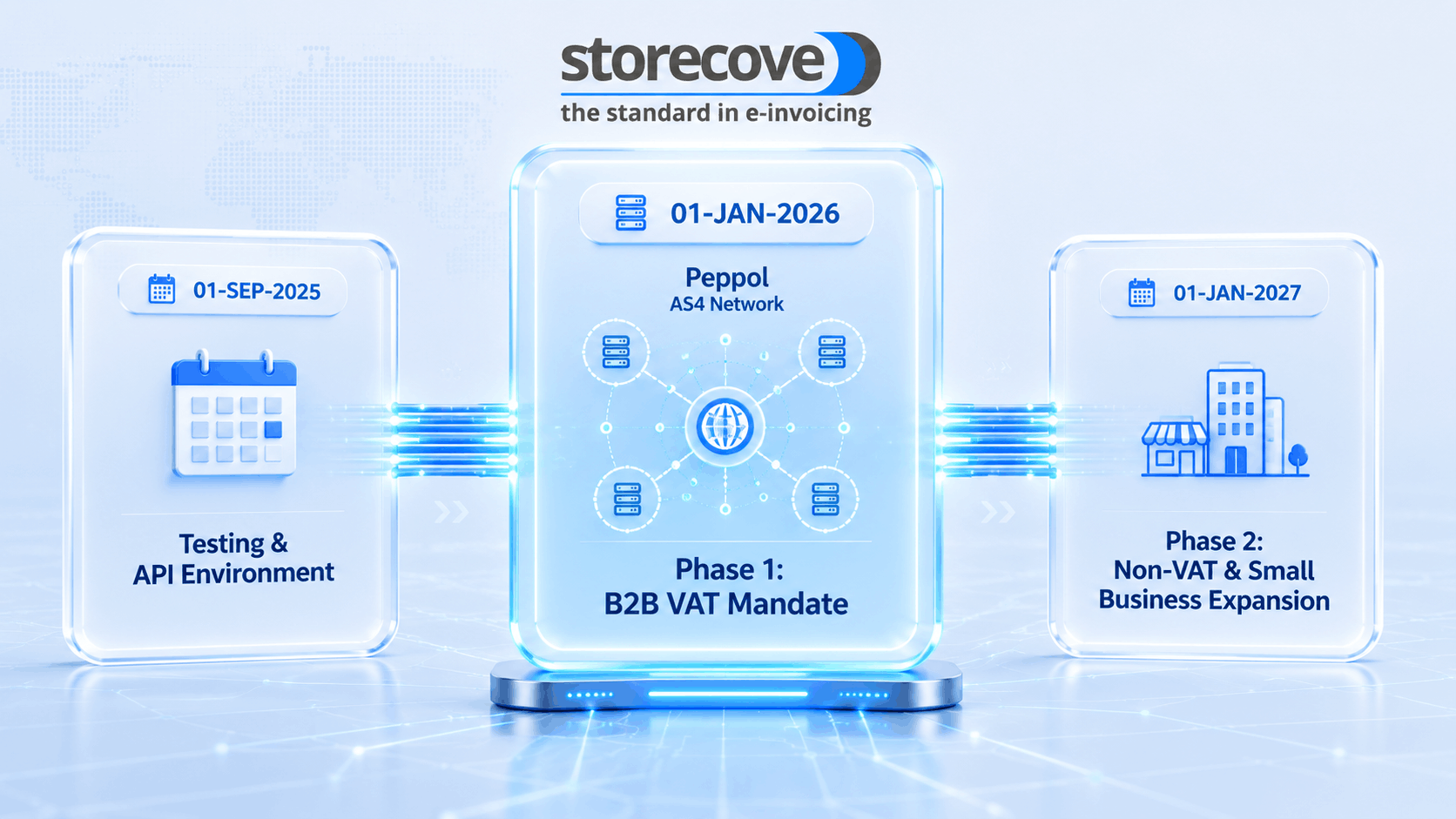
Phase 1: VAT-Registered Taxpayers
All companies, freelancers, and permanent establishments registered for VAT in Croatia must issue and receive structured electronic invoices for all domestic B2B and B2G transactions.
Non-VAT registered businesses are also required to establish inbound receipt capacity to receive and fiscalize electronic invoices issued by their VAT-registered suppliers.
Phase 2: Non-VAT Registered Entities & Small Businesses
Mandatory issuance extends to small enterprises, non-VAT registered entities, micro-budget users, and sole traders. Small traders without integrated accounting systems can utilize the government-provided MIKROeRAČUN web portal to generate and fiscalize invoices manually.
The Role of Peppol in Croatia’s E-Invoicing Ecosystem
The Peppol network (Pan-European Public Procurement Online) serves as a core pillar of Croatia's digital e-invoicing landscape.
While some European countries restrict Peppol usage strictly to public sector (B2G) transactions, Croatia utilizes Peppol-compatible standards and certified Access Point networks to power both B2G and domestic B2B electronic document transport.
Why Peppol is Essential for Croatia Compliance
- Interoperability Across Europe: Peppol uses a four-corner model that connects buyer and seller Access Points seamlessly. A Croatian enterprise connected to a Peppol Access Point can trade electronically with domestic counterparties as well as international partners in Germany, Italy, Austria, and across 30+ global Peppol jurisdictions.
- Standardized AS4 Messaging: Peppol enforces secure, encrypted AS4 transport protocols. Information Intermediaries in Croatia use AS4 endpoints to guarantee secure document transport, transport receipts, and automated error handshakes.
- Addressing via Peppol Directory: Peppol eliminates manual email distribution or proprietary portal logins. Invoices are addressed directly to the buyer's unique Peppol ID.
Core Technical Requirements: EN 16931 and Croatian CIUS
To achieve full compliance, electronic invoices in Croatia must adhere to the European e-invoicing standard EN 16931-1:2017 formatted in UBL 2.1 (Universal Business Language) XML syntax.

Croatia enforces its own national extension, the HR-FISK 2.0 CIUS (Core Invoice Usage Specification), which mandates specific localized data elements:
- OIB Validation: The 11-digit Personal Identification Number (Osobni identifikacijski broj) for both sender and recipient must be included and validated against national registries.
- 6-Digit KPD Product Classification: Every line item on the invoice must be assigned a 6-digit Croatian Classification of Products by Activity (Klasifikacija proizvoda po djelatnostima - KPD) code. Generic European templates do not populate this mandatory Croatian field.
- Digital Certificates & PKI Signing: Electronic invoices and fiscalization messages must be digitally signed using an advanced electronic signature or seal backed by an OIB-linked certificate issued by an approved Croatian Trust Service Provider (such as FINA).
- QR Code Generation: Each fiscalized document contains a verification QR code, allowing recipients and tax auditors to inspect the transaction on the Porezna uprava central database.
- Rejection & Dispute Handshakes: Buyers cannot simply reject an invoice over the phone. A formal XML Application Response (e.g., Peppol BIS 3.0 Response) must be submitted through the network within 5 business days, logging the explicit reason for dispute.
Mandatory E-Reporting and 11-Year Archival Rules
Fiscalization 2.0 introduces continuous lifecycle tracking beyond initial invoice delivery:
Parallel Fiscalization Reporting
When a supplier issues an e-invoice, two messages are created simultaneously: the commercial UBL 2.1 XML sent to the buyer via Peppol/AS4 Access Points, and a specialized fiscalization XML payload transmitted directly to Porezna uprava. The buyer's system must similarly transmit an inbound fiscalization receipt message upon receiving the invoice.
Payment Status Reporting
Taxpayers must report invoice settlement statuses to the Tax Administration. This continuous visibility enables automated pre-filled VAT returns (Prijava PDV-a), reducing administrative overhead for compliant businesses.
11-Year Statutory Data Archival
Under Croatian tax regulations, all electronic invoices, validation responses, AS4 transport logs, and fiscalization tokens must be retained in an immutable, legally compliant electronic archive for 11 years following the end of the fiscal year in which the invoice was issued. The archive must preserve authenticity of origin, content integrity, and legibility throughout the statutory retention period.
Statutory Penalties for Non-Compliance
Croatia enforces strict financial penalties for non-compliance under the Fiscalization Act:
- Legal Entities: Fines ranging from €3,980 to €66,360 for failing to issue, receive, or fiscalize structured e-invoices, or for using uncertified transmission software.
- Sole Traders & Craftsmen: Fines ranging from €3,980 to €39,810.
- Responsible Individuals: Fines ranging from €660 to €6,630 assessed directly against company directors or finance managers.
Additionally, commercial buyers cannot claim VAT input deductions or corporate tax expense deductions on non-compliant, un-fiscalized invoices.
Storecove’s Roadmap for Croatia Compliance
To help international enterprises navigate the complexity of Fiscalization 2.0 without fragmenting their core financial systems, Storecove is actively expanding its global coverage to support Croatia’s incoming e-invoicing framework. Through Storecove’s single RESTful API, businesses will soon be able to manage compliant UBL 2.1 XML generation (HR-FISK 2.0 CIUS), certified Peppol Access Point routing, and automated dual-reporting to the Croatian Tax Administration (Porezna uprava), unlocking seamless B2B and B2G compliance across Croatia alongside Storecove’s 30+ supported global tax jurisdictions.
Read More
 Lauren Kelly
 Lauren Kelly
 Lauren Kelly

Comments